

Samsung Washer Repair in Cleburne, TX
Hard water common to North Texas reservoirs accelerates mineral buildup in Samsung washers, reducing efficiency and shortening component lifespan. Cleburne Appliance Repair connects you with local independent providers who understand how local water quality affects washer performance and can restore your machine quickly. Getting your Samsung back in service without the guesswork saves time and protects your investment.

Samsung Washer Repair for Cleburne Homeowners
Homeowners throughout Cleburne rely on washing machines to keep up with daily laundry, making a Samsung washer breakdown more than just an inconvenience. The hard water common to North Texas, drawn from local reservoirs serving Johnson County, leaves mineral deposits that accumulate inside washers over time, affecting water flow, drum movement, and overall performance. Beyond water quality, the region's spring and summer severe weather—including thunderstorms, hail, and occasional tornadoes—creates power surges that can damage sensitive washer electronics and motor components. These combined pressures mean Samsung washer repair needs in Cleburne are frequent and often urgent.
Cleburne Appliance Repair connects property owners with independent local providers who specialize in Samsung washer repair, diagnosing everything from fill and drain issues to drum, seal, and control board failures. The providers in this network understand the specific wear patterns Samsung washers develop in the area and respond quickly to get your machine running again. Whether you're in Avondale, Belle Meadows, or another neighborhood across Cleburne, a local provider can typically reach your home promptly, assess the problem thoroughly, and discuss repair options with you directly. When your Samsung washer needs attention, connecting with an experienced local technician through this service puts a timely solution within reach.
Common Samsung Washer Error Codes
Samsung documents these twelve codes most often on washers. Seven typically trace to something simple — a blockage, a latch, a setting — and five to a component that needs replacing.
Samsung Washer 4C
Often clearable without a technician
What it means: The washer asked for water and did not get what it expected, so it has stopped rather than run a cycle dry. Samsung shows this as 4C on newer panels, 4E on older ones and nF on some models — one fault, three displays.
Why it happens: Almost always something before the machine rather than inside it: a supply tap not fully open, a kinked fill hose behind the unit, or the small mesh screens where the hoses meet the washer silted up with scale and grit.
What you can check: Check both taps are fully open, then pull the machine out far enough to see the fill hoses are not kinked. If that looks fine, turn the taps off, unscrew the hoses at the machine end and look at the inlet screens for debris.
When to call someone: If the supply is good and the screens are clear, the inlet valve on the machine is next, and that is where it stops being an owner check.
Samsung Washer Ub
Often clearable without a technician
What it means: The load has gone off balance in the tub and the washer will not spin it at speed, because an unbalanced drum at spin speed can damage the machine.
Why it happens: Usually one heavy item on its own — a towel, a bath mat, a single pair of jeans — or a load that has twisted into a rope on one side of the drum.
What you can check: Open the door, redistribute the load by hand and restart the spin. Adding a couple of similar-weight items often settles it; washing one heavy item alone rarely spins well.
When to call someone: If it trips on every load including well-balanced ones, the suspension or the sensor reading the drum may need looking at.
Samsung Washer 4E
Often clearable without a technician
What it means: The same not-filling fault as 4C, shown as 4E on older Samsung panels.
Why it happens: A closed or partly closed tap, a kinked fill hose, or blocked inlet screens where the hoses connect.
What you can check: Work from the wall in: taps fully open, hoses unkinked, then the inlet screens at the machine end.
When to call someone: If water reaches the machine freely and it still will not fill, the inlet valve needs testing.
Samsung Washer SE
Often clearable without a technician
What it means: Water is not leaving the machine at the rate the cycle expects, or is not leaving at all. Shown as 5E, SE, 5C or nd depending on the panel.
Why it happens: The debris filter at the bottom front catches coins, hair grips and lint and eventually packs solid. A kinked drain hose or a standpipe that cannot take the flow does the same thing from further down the line.
What you can check: Open the small flap at the bottom front, drain the residual water into a tray and clean the filter. Then check the drain hose behind the machine for kinks and that it is not pushed too far into the standpipe.
When to call someone: If the filter is clean and the hose run is clear, the drain pump itself needs testing.
Samsung Washer UE
Often clearable without a technician
What it means: The same unbalanced-load condition as Ub, shown as UE on some Samsung models.
Why it happens: A single heavy item, or a load that has bunched to one side of the drum.
What you can check: Redistribute the load by hand and restart the spin.
When to call someone: If balanced loads also trip it, the drum suspension is worth checking.
Samsung Washer dC
Often clearable without a technician
What it means: The washer cannot confirm the door is shut and locked, so it will not start or will stop mid-cycle.
Why it happens: Most often laundry caught in the door seal stopping it closing flush, or a door that has been slammed rather than pushed shut.
What you can check: Open the door fully, clear anything caught around the seal, and close it firmly without forcing it. Check the latch and the strike plate for anything obstructing them.
When to call someone: If nothing is obstructing it and the lock still will not engage, the door lock assembly is the usual cause.
Samsung Washer SUd
Often clearable without a technician
What it means: The washer has detected far more foam than the drum is designed to handle, and is pausing to clear it before continuing.
Why it happens: Usually too much detergent, or a standard detergent used in a high-efficiency machine, which foams several times more than an HE formula.
What you can check: Let the machine run its own suds-clearing routine rather than cutting the cycle short. Next load, reduce the dose and check the detergent is HE-rated if your machine needs one.
When to call someone: If it appears with a correct HE dose, something may be holding water in the drum and it is worth having checked.
Samsung Washer 5C
Often clearable without a technician
What it means: The same not-draining fault as 5E and SE, shown as 5C on some Samsung panels.
Why it happens: A packed debris filter at the bottom front, a kinked drain hose, or a standpipe that cannot take the flow.
What you can check: Clean the filter behind the flap at the bottom front, draining the residual water into a tray first, then check the hose run behind the machine.
When to call someone: If the filter is clean and the hose is clear, the drain pump needs testing.
Samsung Washer nF
Often clearable without a technician
What it means: The washer is not filling — the same fault Samsung shows as 4C and 4E on other panels.
Why it happens: A tap that is not fully open, a kinked fill hose, or the inlet screens where the hoses meet the machine blocked with scale and grit.
What you can check: Check both taps, straighten the hoses, then turn the taps off and inspect the inlet screens at the machine end.
When to call someone: If water reaches the machine freely and it still will not fill, the inlet valve is next.
Samsung Washer OE
Usually needs a technician
What it means: There is more water in the tub than there should be, so the washer has stopped filling and is trying to pump out.
Why it happens: Normally the inlet valve passing water when it has been told to close, rather than anything to do with the load or detergent.
What you can check: Turn the supply taps off at the wall so no more water can arrive. There is no owner-side fix for a valve that will not shut.
When to call someone: Promptly — a valve stuck open is a flood risk as well as an error code.
Samsung Washer 0E
Usually needs a technician
What it means: The same overfill condition as OE, shown with a zero on some panels.
Why it happens: An inlet valve letting water through when it should be closed.
What you can check: Shut the taps at the wall to stop the fill. Nothing else here is an owner check.
When to call someone: Promptly, for the same reason as OE.
Samsung Washer ddC
Often clearable without a technician
What it means: The AddWash door — the small hatch in the main door — is not registering as closed and latched.
Why it happens: It is easy to push shut without seating the catch, and a trapped sock or glove will stop it closing flush.
What you can check: Open the AddWash door fully, clear anything caught in it, and press it closed until the catch engages.
When to call someone: If it is properly shut and still reads open, the hatch switch needs checking.
Samsung Washer HE
Usually needs a technician
What it means: A fault in the heater circuit, so the machine cannot bring the wash water up to the temperature the cycle asked for.
Why it happens: A component failure rather than anything that builds up, so it usually appears without warning.
What you can check: Nothing here is an owner check — the heater and its circuit are inside the machine.
When to call someone: When you see it. Cold-water cycles may still run, but the machine is not doing what the programme selected.
Samsung Washer 5E
Often clearable without a technician
What it means: The same not-draining fault Samsung shows as SE and 5C on other panels.
Why it happens: A packed debris filter at the bottom front, a kinked drain hose, or a standpipe that cannot take the flow.
What you can check: Open the flap at the bottom front, drain the residual water into a tray and clean the filter, then check the hose run.
When to call someone: If the filter and hose are clear and it still will not drain, the drain pump needs testing.
Samsung Washer LE
Usually needs a technician
What it means: Moisture has been found somewhere inside the machine it should not be — a leak, not a setting.
Why it happens: Water escaping from a hose connection, a seal or the tub reaches a sensor that shuts the cycle down.
What you can check: Turn the supply taps off at the wall and stop using the machine. The code says water is escaping but not from where.
When to call someone: This needs a technician — tracing the source means getting behind or under the machine.
Samsung Washer 3E
Usually needs a technician
What it means: A motor fault — the drive is not behaving the way the control expects.
Why it happens: A failure in the motor or its control circuit rather than anything to do with the load or detergent.
What you can check: Nothing here is an owner check. A single power-cycle at the breaker clears a one-off glitch; a code that returns is real.
When to call someone: If it comes back after a power cycle, the motor circuit needs testing.
| Code | What it means |
|---|---|
| Ub / UE / U6 | The load is unbalanced inside the tub, so the washer cannot spin it safely. |
| 5E / SE / 5C / nd | Water is not draining at the rate it should, or is not draining at all. |
| dC / dC1 / dL | The door is not being detected as closed and locked, so the cycle will not run. |
| SUd / Sd | An over-sudsing condition has been detected and the machine is pausing to let the foam clear. |
| OE / 0E / OC | There is too much water in the washer, which normally means the inlet valve is passing water when it should be shut. |
| LE / 1C | Moisture has been detected somewhere inside the machine that it should not be, which is a leak rather than a setting. |
| HE / HC | A fault in the heater circuit, so the machine cannot bring the water up to temperature. |
| 3E / 3C | A motor fault — the drive is not behaving as the control expects. |
| tE / tC | The temperature sensor is reporting a reading outside the range the cycle allows. |
| bE2 / 6E2 | A button on the control panel is reading as stuck or continuously pressed. |
Don't see your code? Call (817) 446-9922 — we'll help you track it down.
Common Samsung Washer Problems We Fix
Won't Drain Water
A clogged drain hose, filter, or pump is usually behind standing water after a cycle. The independent providers Cleburne Appliance Repair connects you with can clear blockages and test the drain system to get your washer working again.
Not Spinning Clothes
When clothes stay soaked after the spin cycle, a worn drum belt, clutch failure, or motor issue is often the culprit. Local providers diagnose and repair these mechanical faults to restore proper spin performance.
Leaking Water
Leaks during or after a wash cycle typically stem from damaged door seals, cracked tubs, or loose hose connections. The independent providers this service connects you with locate the source and repair or replace the faulty part.
Error Code on Display
Samsung washers display error codes like 4C to signal drainage, sensor, or water-supply problems. Local repair providers this network connects you with read the code, identify the root cause, and perform the necessary fix.
Loud or Vibrating
Excessive noise or shaking during a cycle often means a worn drum bearing, foreign object in the tub, or damaged suspension components. Providers in the Cleburne area can inspect and repair these issues.
Won't Start or Fill
If your Samsung washing machine won't power on or won't fill with water, the issue may be electrical, a faulty inlet valve, or a control board malfunction. Providers Cleburne Appliance Repair connects you with can test and restore function.
Why Cleburne Homeowners Trust Samsung Washer Repair
Samsung Washer Repair Expertise
Local providers connected through this service understand Samsung washer systems inside out. They diagnose drum issues, control board failures, and seal problems quickly, getting your laundry routine back on track.
Fast Samsung Washer Repair Response
When your Samsung washer stops mid-cycle, fast response matters. Cleburne Appliance Repair connects you with nearby independent providers who prioritize Samsung washer repairs, minimizing downtime for your household.
Clear Samsung Washer Repair Communication
Independent providers in the network explain what's wrong with your Samsung washer and why repair costs what it does. No surprises—just honest answers and straightforward solutions tailored to your situation.
Samsung Washers & Power Surge Protection
North Texas spring storms bring sudden electrical surges that stress Samsung washer electronics and motors. Local providers connected here understand these power-related failures common in the region and repair them effectively.
How Our Repair Service Works
Schedule Your Samsung Washer Repair Visit
Contact Cleburne Appliance Repair to describe your Samsung washer issue—whether it's a drainage problem, drum noise, or electronic fault. A local independent repair provider will confirm availability and schedule a time that works for your home.
Technician Diagnoses Your Samsung Washer
The independent provider inspects your Samsung washer to identify the root cause, from worn seals to control board failures. In North Texas, hard water mineral buildup can accelerate wear on Samsung washers' internal components, a factor the technician will assess during diagnosis.
Samsung Washer Repair and Follow-Up
The independent provider performs the repair—replacing parts, clearing blockages, or resolving electrical issues—and tests your Samsung washer to confirm it's working. You'll receive information about what was fixed and guidance on ongoing care for your appliance.
Need appliance repair in Cleburne? Our technicians can help fast.
Call (817) 446-9922Samsung Washer Repair Across Cleburne
Water quality plays a significant role in how Samsung washers perform across Cleburne. The hard water supplied by North Texas municipal sources leaves mineral deposits that accumulate inside wash drums, valve assemblies, and hose connections over time. This buildup can reduce water flow, create spotting on clothes, and force the machine to work harder during cycles—all of which put extra strain on the motor and electronic controls. Homeowners in established neighborhoods like Bellevue Crest and newer communities like Belle Meadows alike face the same mineral-related wear, making regular service and attention to water inlet screens essential for long-term reliability.
Severe weather across the region also affects Samsung washer electronics and power components. Spring and summer thunderstorms, hail, and occasional tornadoes generate power surges that can damage control boards and motor circuits without obvious external signs. A sudden electrical spike may leave a washer unresponsive, cause error codes, or trigger a shutdown mid-cycle. Property owners who experience weather events should have their Samsung washers checked promptly, since internal electronic damage may not show symptoms immediately. Fast access to local repair providers through Cleburne Appliance Repair helps identify and resolve these power-related issues before they become costly failures.
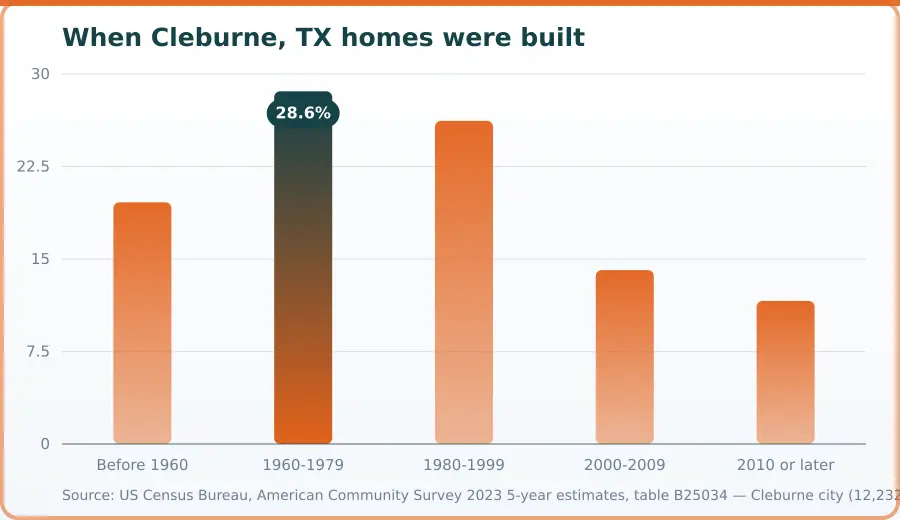
| Period | When homes were built (%) |
|---|---|
| Before 1960 | 19.6 |
| 1960-1979 | 28.6 |
| 1980-1999 | 26.2 |
| 2000-2009 | 14.1 |
| 2010 or later | 11.6 |
Source: US Census Bureau, American Community Survey 2023 5-year estimates, table B25034 — Cleburne city (12,232 housing units). Retrieved November 10, 2026.
Samsung Washer Repair FAQ — Cleburne, TX
Samsung Washer Repair addresses problems like drum issues, water leaks, drainage failures, and control panel malfunctions. A local repair provider will diagnose the specific fault, replace worn seals or pumps if needed, and test the washer to confirm normal operation. The scope depends on what the technician finds during inspection.
Cleburne Appliance Repair connects you with independent local providers who typically respond to repair requests within the area promptly. Exact response times vary based on current workload and your location within Cleburne, but same-day or next-day availability is often possible for Samsung Washer Repair appointments.
Pricing for Samsung Washer Repair depends on the specific problem—a simple hose replacement costs less than a motor or pump failure. Call-out fees, parts needed, and labor rates set by the independent provider all play a role. Contact a local Cleburne repair provider directly for a diagnosis and quote on your Samsung washer.
Before the technician arrives for Samsung Washer Repair, clear the area around your washer and note any symptoms you've observed—strange noises, error codes, or when the problem started. Turn off the water supply if there's a leak. Have your washer model number ready; this helps the provider prepare parts and tools ahead of time.
Regular maintenance extends your Samsung washer's life. Wipe seals clean, avoid overloading, and use the correct detergent type. Check hoses annually for cracks. In Cleburne's region, hard water mineral buildup can affect performance over time, so occasional descaling or filter cleaning may help prevent future issues requiring repair.
North Texas spring and summer storms bring the risk of power surges that can damage Samsung washer electronics and controls. If your washer suddenly stops working after a thunderstorm, a technician can check for electrical or component damage. Surge protection on your home's circuits may reduce this risk for appliances like your washer.
More Repairs for This Brand
Homeowner Safety Toolkit
Confirm Who You're Hiring in Cleburne, TX
Before you hire anyone, use these independent national resources to confirm credentials, standards, and track record.
CPSC
Check whether your specific appliance has an open safety recall before paying for a repair — some recalls cover the fix or a replacement for free.
Check for RecallsNFPA
A poorly repaired dryer, range, or water heater is a real fire risk. The National Fire Protection Association's home safety guidance covers what to check after any appliance service.
Appliance Fire Safety TipsBBB
Look up any appliance repair company's complaint history, customer reviews, and accreditation status — a free, independent check before you hire.
Check StandingBook your Cleburne appliance repair today.
Call (817) 446-9922Where We Cover Near Cleburne, Texas
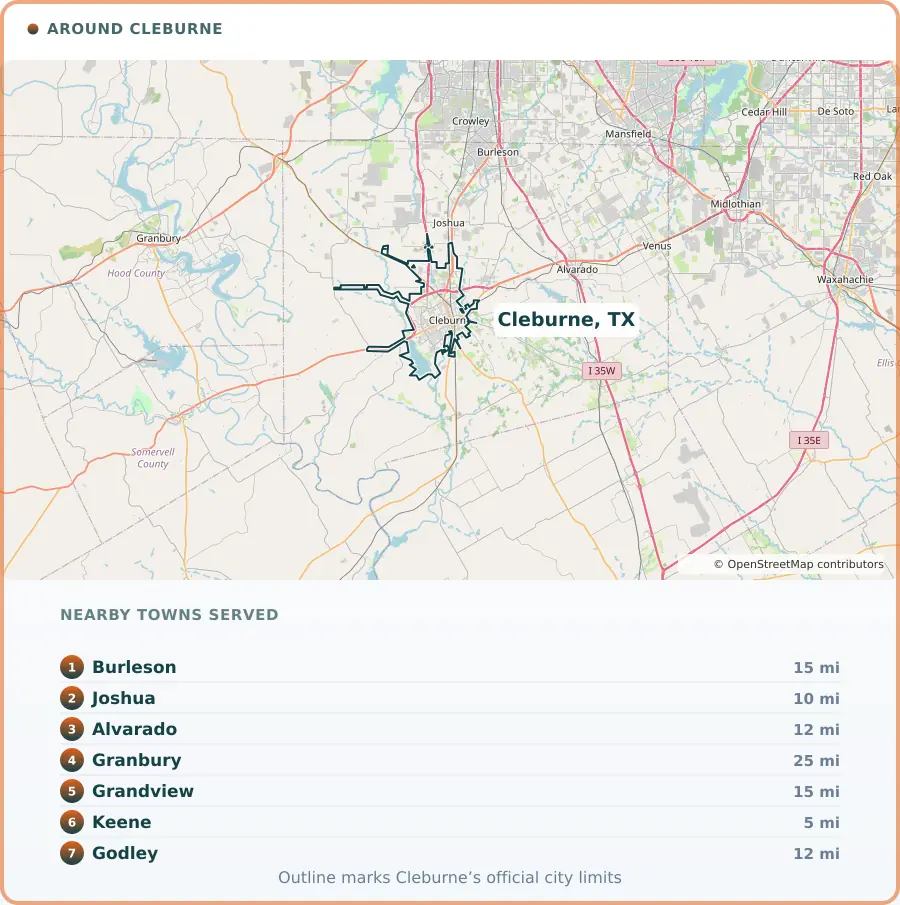
Cleburne, TX is the centre of the service area, which extends to 7 surrounding towns. The map shows how far that reaches.
Cleburne, TX Information
Cleburne, TX anchors Johnson County as a city of roughly 31,000 with deep railroading roots. The BNSF Railway rail yard and repair shops remain a defining presence, a reminder of Cleburne's history as a North Texas rail hub, while manufacturing, healthcare, agriculture, and ranching round out an economy that keeps the city humming. Growth along the Chisholm Trail Parkway corridor continues to bring new homes and retail, and Cleburne still functions as a bedroom community for folks working around the wider region.
Downtown Cleburne's historic district gives the city a walkable, small-town feel, while newer neighborhoods like Bent Creek reflect its steady residential growth. Locals turn out for Cleburne Railroaders baseball, and major employers such as Cleburne ISD, Texas Health Hospital Cleburne, and Load King Trailers reflect a community built on rail, healthcare, and manufacturing working side by side.
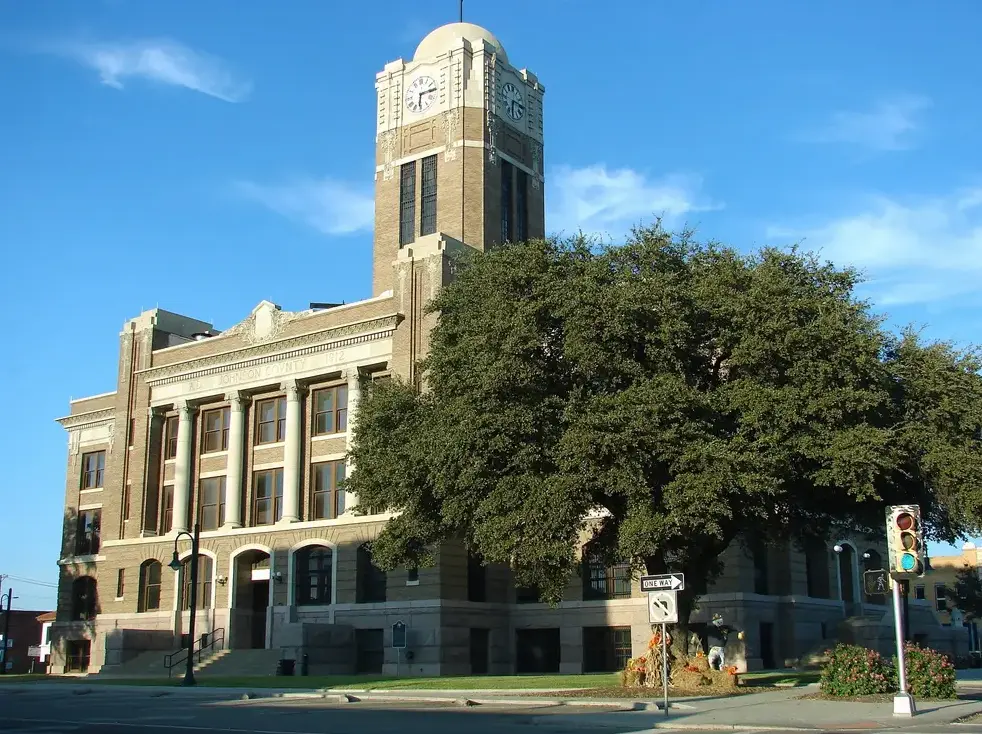
Photo: Loadmaster (David R. Tribble) This image was made by Loadmaster (David R. Tribble). Email the author: David R. Tribble Also see my personal gallery at Google Photos, CC BY-SA 3.0